Showing posts with label nanoparticle. Show all posts

Sunday, July 26, 2015

NanoMedicine: Fighting Heart Disease

According to the Center of Disease Control (CDC), the leading cause of death in the United States is Cardiovascular disease, which claims approximately 611,000 lives per year and includes symptoms like Myocardial infarctions (MI) (Heart attacks) (source). Heart attacks occur when an artery in the heart becomes blocked - often through blood clots that form when atherosclerotic plaque (caused by an unhealthy diet) ruptures - as explained in the Ted-Ed Video here.
How blood pressure works - Wilfred Manzano - Ted-Ed

Due to its high prevalence in advanced countries, much research has been done and many drugs developed to help treat the disease. Nanotechnologies have been developed, at the Laboratory of Nanomedicine and Biomaterials at Brigham and Women's Hospital in Boston, USA, that may  aid in the treatment of this disease by aiding in the delivery of  cardiovascular drugs directly to the atherosclerotic plaque sites. Specifically, they developed  a 'nanodrone' that was able to attach to the plaque and deliver the drug Annexin A1, which resulted in decreased inflammation, decreased plaque size and increased thickness of the collagen layering the plaque (helping prevent plaque rupturing and blood clotting) in mice. The result was that mice that relieved the treatment of the drug did not experience an MI. Moreover, when the same drug was administered without the nanodrone, the treatment was ineffective, as when the nanoparticle was administered without the drug.
A Depiction of the 'Nanodrone'
Clearly, the application of nanotechnologies for delivery of drugs is a serious one that will help make treatments more effective even outside this specific example. It shows that nanotechnology will enhance modern medicine and help improve the quality of human life, which is one of the ultimate goals of technology and medicine. 

To find out more about cardiovascular disease, click here.
To find out more about Myocardial infarction, click here.
To find out more about this nanotechnology, click here.

Saturday, July 25, 2015

Nanotechnology Could Cure Teenage Acne Forever

Acne is a skin infection that occurs when skin pores get congested, often with a naturally occurring, oily lubricant called sebum - created by the sebaceous gland. During adolescence, when the skin in changing, many teenager's sebaceous glands over produce sebum, leading to congestion, infection, and, ultimately, acne.
Diagram of a Normal Follicle
Most modern treatments of acne work by treating the symptoms of the infection or by trying to diminish sebum production chemically. Often times, these drugs also cause unwanted side effects - like skin dryness - or resistance. However, researchers at University of California at Santa Barbra, have developed a possible alternative to current treatments. Rather than a purely symptomatic treatment, they have utilized nanotechnologies to directly destroy the over-productive sebaceous, thus stopping the production of sebum and curing the resulting acne.

More precisely, the drug is a silicon oxide molecule with a gold encasement in the nanosize region. It's size is particularly useful for its delivery as it is able to enter the pores transdermally - that is, without injection or consumption.

The treatment has three phases, illustrated below. The first is to apply the nanoparticle formulation to the skin. The second is to use low-frequency ultrasound to 'push' the nanoparticles into the follicle - this is the delivery system. The last step uses a laser to activate the treatment and effectively cure the acne.
A Diagram of the Phases of the Nanoparticle
The final step works through a process called Surface Plasmon Resonance (SPR). Illustrated in the diagram, SPRworks when a beam of light is shined at a metal surface and the light resonates with the metal in such a way that a specific wavelength is converted from light energy to mechanical energy or heat - as seen below with the "plasmon wave".

The researchers used this property of metal in their nanoparticle. Once the nanoparticles have entered the follicle (the second phase), a laser (which is a beam of light at a single wavelength) is pointed at the targeted area. Due to the particle being a metal, an SPR effect is created, leading to heat production that deactivates the overactive sebaceous cells.

Diagram of Surface Plasmon Resonance
Although the treatment is not yet in the market, it is currently undergoing clinical studies, where side effects and efficacy are being studied.

It is clear that the work on this drug has not only been useful for the treatment of acne, but has also provided for a new delivery system (via ultrasound) and proves to the world the eminence of nanotechnologies.

To learn more about the treatment, click here.
To learn more about Surface Plasmon Resonance, click here.

Thursday, August 21, 2014

Solar splitting

One of the great problems that face humanity at the moment is global warming and climate change. It is well known that humans are releasing more and more CO2 into the atmosphere by burning fossil fuels.

Graph of CO2 emissions and where they are released from
Pie chart showing where we get our energy from
In response to this up and coming crises, new research and accompanying companies have begun to develop new energy technologies, which they hope will become the successor of fossil fuels. These new renewable energy sources consist mainly of Hydroelectric power. 8 of the 9% of energy used by Americans comes from hydroelectricity.  

The last 1% of energy sources include solar and wind. Both have received much press, but it is clear that they have yet to take hold. However, there have been several recent advancements in solar technology, that may  help the platform become a major contributor to our energy reservoir. 

Solar panels and other solar technologies have yet to take of. One reason for this reluctance is the cost for the infrastructure. However, the prices of solar panels have dropped dramatically in the last several decades. This is a good sign for the industry, as it will obviously solicit a positive response from consumers.

Unfortunately, there remains another problem which holds solar panels back. This is that solar panels cannot produce energy at night. It has to thus store excess energy  in expensive batteries. However, a team at Stanford has made a recent development that may make an alternate form of energy storage possible.

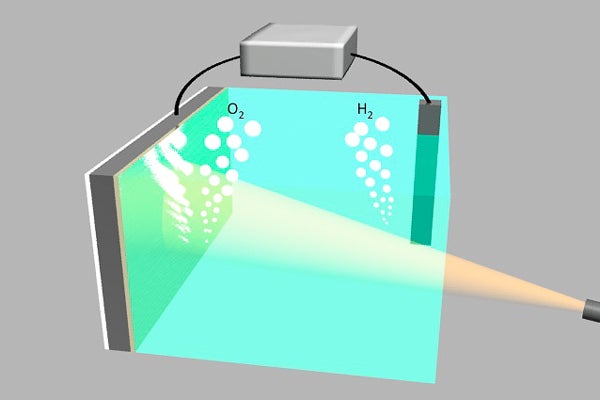
The development is based off of the principle that water requires energy to be broken apart into its bare components, hydrogen and oxygen, and that energy  is released when the two fuse to make water. Water is classically separated by putting two electrodes of different charges into the water, causing the water to break apart. This has long been established, but the separation of water has always required much energy.

A team at Stanford has managed to decrease this energy, in a way that might help accelerate solar panel integration into society. For several years, people have been trying to harness the principle mentioned above by using solar energy to separate the water, and then when there is no sunlight, to use the created hydrogen  and oxygen to recreate pure water and release energy. However, up until now, the separation has required too much energy.

The Experiment at Standford which uses a 1.5 volt AAA battery to
Separate water into H and O2
In the past, there has been a major problem: Silicon degrades when it comes into contact with water. Thus, the option to use light energy to charge electrodes and separate water with just sunlight was not an option (both because of the amount of energy required and because of the silicon degradation. The problem was originally solved by teams who coated silicon electrodes in iridium or other expensive materials. However, this solution was expensive. 
The team at Stanford used a simple nickel nanolayer to solve this problem. The nanolayer (which is inexpensive and which doesn't corrode over longer periods than the iridium covered electrodes ) allows the silicon to absorb light and to not degrade in the water.

Using lithium, the team was also able to prolong the lifespan of the electrodes  to up to 80 hours without any corrosion.

Diagram of the experiment done at stanford
Thus, this development may be able to cheapen the creation of hydrogen fuel by solar energy, and help solar panels come into the mass market. Click Here to Read More

Friday, August 31, 2012

Nanoparticles

Unlike many other areas of nanotechnologies, Nanoparticles is one that has already been looked into for a while and is not in its beginning stages. In fact, it was used in the middle ages to glaze pottery. In modern times, we have been studying nanoparticles since the 1970s-80s.
(Source)

The reason Nanoparticles  are so important is because of its special properties of being tiny, that it can interact with other nano/microparticles, and that the differences in size and shape of a nanostructure makes a difference to its properties.
1 cm by 1 cm by 1 cm

Nanoparticles are interesting because of the differences of the two objects above. The cube has a side length of 1 cm and the pane of steel has a length of 50 nm and a with of only 5 nm. To compare the two objects, imagine we had a cube of iron 1 meter x 1 meter x 1 meter and one triple the size of it. Analytically, the two the same properties regardless of its size or shape. Therefore, one could reach the conclusion that the two figures above have the same properties. Unfortunately, this is not the case. As the size of an object gets smaller, the size and shape of an object does matter, thus leading to many possibilities of innovation and creations that has scientist so hyped about it.

It is at these nanoscopic  sizes that quantum functions come in to play. From here there are different properties in a material or element than what we might see at larger sizes. For example,Copper is malleable when it is large, but if it is less than 50 nm, it becomes very strong. Ferromagnetic  materials in properties after 10 nm. Ferromagnetic   materials are used to store memory. However, after 10 nm it no longer works for memory because the direction of magnetism changes direction.

Even without understanding the details embedded within nanoparticles, the one thing to remember is that size and shape do effect an object's properties when at the nanoscale because of quantum physics.