One of the great problems that face humanity at the moment is global warming and climate change. It is well known that humans are releasing more and more CO2 into the atmosphere by burning fossil fuels.
 Unfortunately, there remains another problem which holds solar panels back. This is that solar panels cannot produce energy at night. It has to thus store excess energy in expensive batteries. However, a team at Stanford has made a recent development that may make an alternate form of energy storage possible.
Using lithium, the team was also able to prolong the lifespan of the electrodes to up to 80 hours without any corrosion.
Thus, this development may be able to cheapen the creation of hydrogen fuel by solar energy, and help solar panels come into the mass market. Click Here to Read More
 |
| Graph of CO2 emissions and where they are released from |
 |
| Pie chart showing where we get our energy from |
In response to this up and coming crises, new research and accompanying companies have begun to develop new energy technologies, which they hope will become the successor of fossil fuels. These new renewable energy sources consist mainly of Hydroelectric power. 8 of the 9% of energy used by Americans comes from hydroelectricity.
The last 1% of energy sources include solar and wind. Both have received much press, but it is clear that they have yet to take hold. However, there have been several recent advancements in solar technology, that may help the platform become a major contributor to our energy reservoir.
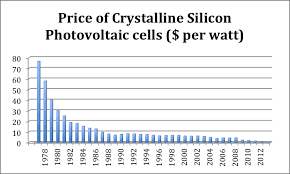
Solar panels and other solar technologies have yet to take of. One reason for this reluctance is the cost for the infrastructure. However, the prices of solar panels have dropped dramatically in the last several decades. This is a good sign for the industry, as it will obviously solicit a positive response from consumers.
The development is based off of the principle that water requires energy to be broken apart into its bare components, hydrogen and oxygen, and that energy is released when the two fuse to make water. Water is classically separated by putting two electrodes of different charges into the water, causing the water to break apart. This has long been established, but the separation of water has always required much energy.
A team at Stanford has managed to decrease this energy, in a way that might help accelerate solar panel integration into society. For several years, people have been trying to harness the principle mentioned above by using solar energy to separate the water, and then when there is no sunlight, to use the created hydrogen and oxygen to recreate pure water and release energy. However, up until now, the separation has required too much energy.
 |
| The Experiment at Standford which uses a 1.5 volt AAA battery to Separate water into H and O2 |
In the past, there has been a major problem: Silicon degrades when it comes into contact with water. Thus, the option to use light energy to charge electrodes and separate water with just sunlight was not an option (both because of the amount of energy required and because of the silicon degradation. The problem was originally solved by teams who coated silicon electrodes in iridium or other expensive materials. However, this solution was expensive.
The team at Stanford used a simple nickel nanolayer to solve this problem. The nanolayer (which is inexpensive and which doesn't corrode over longer periods than the iridium covered electrodes ) allows the silicon to absorb light and to not degrade in the water.
Using lithium, the team was also able to prolong the lifespan of the electrodes to up to 80 hours without any corrosion.
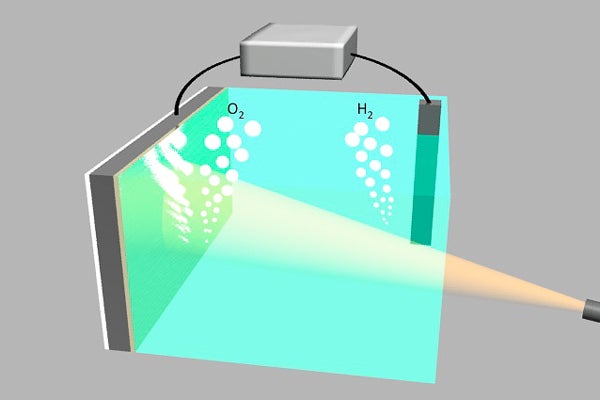 |
| Diagram of the experiment done at stanford |


